Peptide reconstitution looks simple on paper. A measured amount of solvent is added to a vial, the concentration is calculated, and the prepared solution is handled according to the requirements of the experiment. The trouble is that several small decisions sit inside that supposedly simple sequence. One misplaced decimal, one unit conversion done from memory, or one assumption about syringe markings can change the result.
Reconstitution is therefore better treated as a short calculation workflow than as one line of arithmetic. The useful version is repeatable, easy to check, and clear enough that another person can reconstruct what was done from the notes alone.
The arithmetic itself is rarely advanced. What makes the task fragile is that the numbers come from different places and describe different things. A vial label gives mass, a protocol may specify a target amount, and the measuring device deals in volume. Those layers have to stay aligned.
Start With the Numbers That Actually Matter
Confusion usually begins before the math does. Labels, lab notes, and supplier documentation may use different units, while syringes and pipettes introduce another measurement scale. Mixing those pieces too early makes a simple calculation harder than it needs to be.
Write down the core inputs first:
- Peptide quantity in the vial;
- Volume of diluent being added;
- Final concentration after reconstitution;
- Volume that corresponds to the amount required for the experiment.
Keep the unit beside every number. Writing 5 instead of 5 mg, or 0.2 instead of 0.2 mL, strips away context that feels obvious in the moment but may not be obvious an hour later.
It also helps to avoid switching back and forth between milligrams, micrograms, milliliters, and syringe units. Convert once, record it, and work from that value rather than performing the same conversion repeatedly.
Concentration Comes Before Volume
A common mistake is jumping directly from vial size to syringe markings. That skips the central number in the process: concentration.
Once the peptide quantity and diluent volume are known, concentration becomes the reference point for the rest of the calculation. From there, a required amount can be translated into a liquid volume.
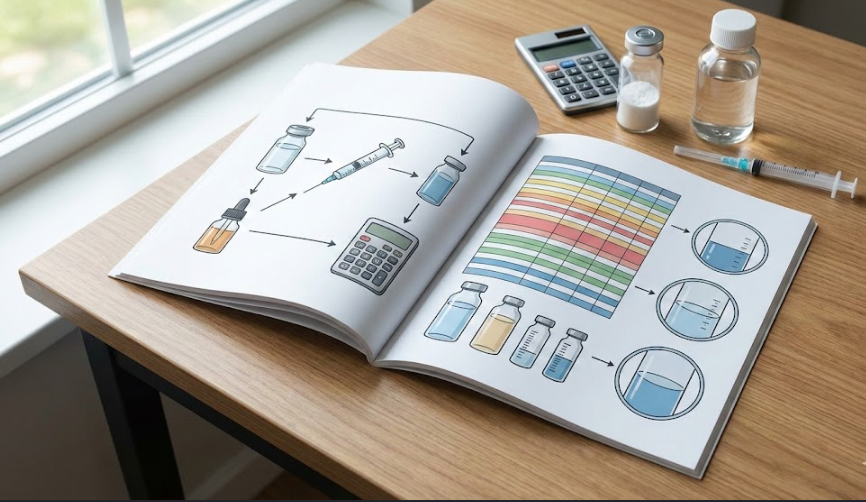
The calculation path can be kept short:
- Identify the total peptide quantity;
- Identify the total liquid volume;
- Calculate concentration per milliliter;
- Convert the required amount into liquid volume;
- Match that volume to the measuring device.
The figures change from one setup to another, but the sequence stays useful because each stage can be checked separately.
A digital tool can reduce the amount of arithmetic involved. A reconstitution calculator is particularly useful when several units need to be converted or when a manual result needs an independent check. It should support the calculation, not substitute for knowing what each input represents.
Small Unit Errors Create Large Differences
Most reconstitution mistakes are not difficult mathematical failures. They are ordinary unit errors.
Milligrams and micrograms are easy to confuse because both appear frequently in peptide documentation. One milligram equals 1,000 micrograms, so a missed conversion changes the result dramatically. Similar trouble appears when volume is written in milliliters while the measuring device uses smaller increments or a separate unit scale.
A few habits make those errors easier to spot:
- Write the unit after every intermediate result;
- Avoid mental conversions when more than one unit changes;
- Keep decimal places consistent in your notes;
- Recalculate results that look unusually small or large;
- Compare the final volume with the physical capacity of the syringe or pipette.
A mathematically valid answer can still be unusable at the bench. If the calculation produces a volume below the device’s readable increment, or larger than the total solution volume, the problem is visible before anything is measured.
The Measuring Device Is Part of the Calculation
Correct arithmetic does not guarantee accurate measurement.
Syringes and pipettes differ in scale, capacity, and precision. A calculated volume means little if the selected device cannot reproduce it reliably. That is why equipment should be considered while the numbers are being worked out, not after.
Check three things before finalizing the setup:
- The smallest readable increment on the device;
- Whether the scale shows volume directly or uses another unit system;
- Whether the required volume sits comfortably within the device’s working range.
An awkward result is often a sign that the setup deserves another look. In a controlled research context, changing the chosen reconstitution volume may sometimes make later measurements more practical, provided that change fits the protocol and the material specifications.
Keep a Calculation Record That Can Be Audited
A note that says “add 2 mL” does not explain much. It gives no indication of how that value was chosen, what concentration it creates, or which units were converted along the way.
A stronger record keeps the original inputs and the arithmetic together. That makes it possible to trace a strange result to one step rather than trying to reconstruct the entire process from memory.
A compact worksheet might contain:
- Vial content and unit;
- Diluent type and volume;
- Calculated concentration;
- Required experimental amount;
- Corresponding liquid volume;
- Device type and scale;
- Independent calculation check;
- Date and initials.
Consistency matters more than elaborate formatting here. The same labels should mean the same thing every time, and abbreviations should be obvious to someone other than the person who wrote them.
See also: Why Choosing a 24 Hour HVAC Company Is Essential for Homes and Businesses
Use Redundancy Where It Actually Helps
Double-checking is only useful when the second check is genuinely independent. Repeating the same calculation in the same order can reproduce the same mistake.
A stronger approach uses a different route. Calculate manually, then compare the result with a trusted calculator. Another option is to have a second person work from the original inputs without seeing the first answer.
The highest-value checks usually sit in three places: unit conversion, concentration, and the conversion from concentration to measurable volume. Those are also the points where a small error can travel furthest through the rest of the worksheet.
Routine calculations become easier to trust when the process makes errors visible. Explicit units, realistic measurement limits, written inputs, and an independent check leave less room for guesswork, especially when the same type of reconstitution is repeated across multiple experiments.